Not every article that mentions your brand is worth the same to you. A detailed story about your product launch matters more than a one-line mention in an industry roundup. Both count as media coverage, but they do not have the same impact on visibility or reputation.
That is where media coverage classification helps.
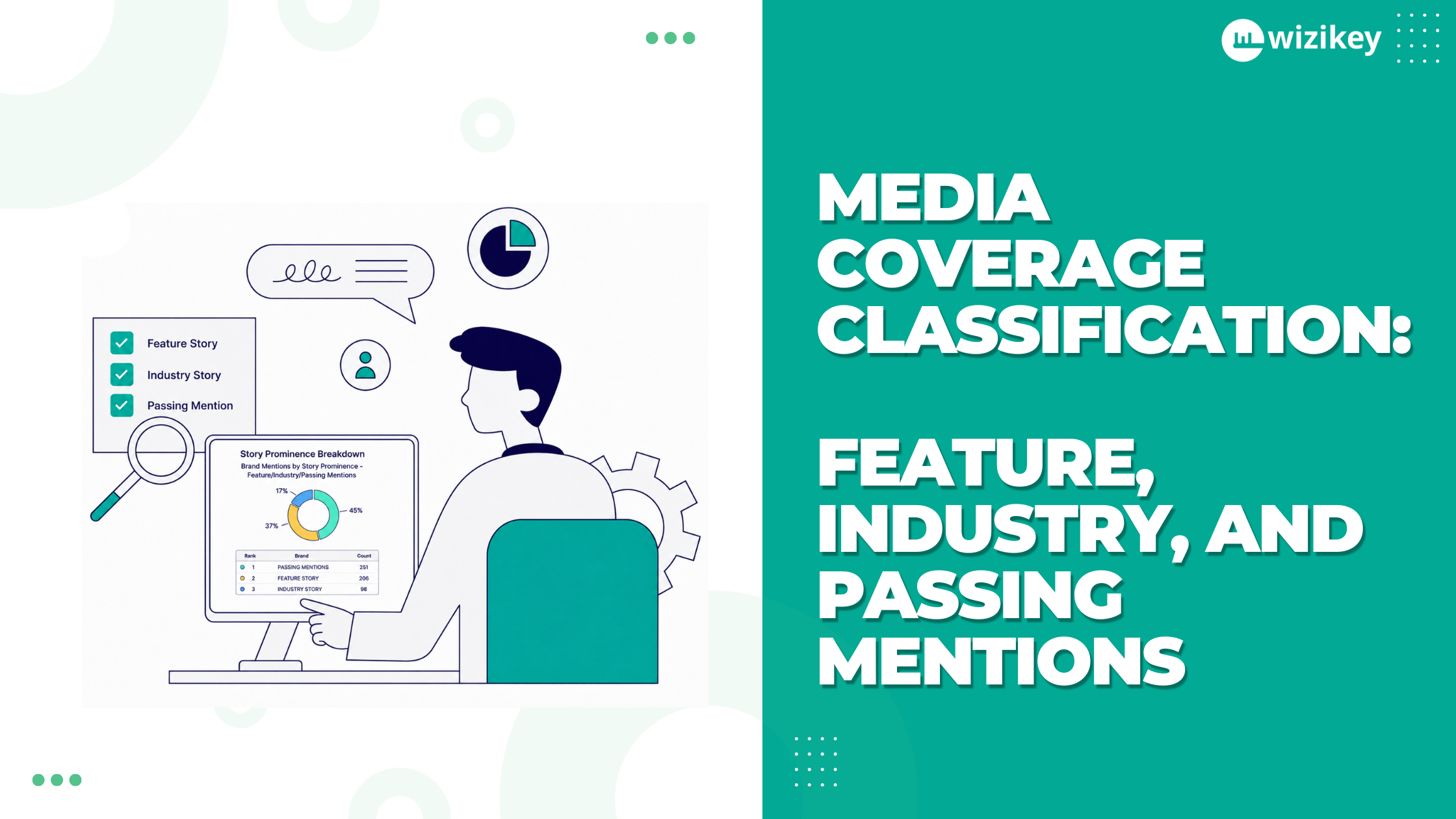
That’s why Wizikey automatically classifies every article into one of three types: Feature Story, Industry Story, or Passing Mention. Here’s what each one means, and why the distinction matters for how you read your coverage.
How media coverage classification works
When an article comes in, Wizikey reads it and decides how important that article really is to your brand. It looks at how prominently your brand features in the piece and based on that, sorts the article into one of three types.
What is a Feature Story?
A Feature Story is coverage where your brand is the main subject, the article is genuinely about you, not just mentioning you along the way. If your brand appears in the headline, that’s an automatic giveaway that the story is built around you. Beyond the headline, an article also earns Feature Story status when your brand comes up multiple times and keeps recurring across different parts of the piece, rather than being confined to one spot.
This is your strongest, most valuable coverage, the kind you’d want to lead with in a report.
What is an Industry Story?
An Industry Story is coverage where your brand has a real, meaningful presence but isn’t the central focus. Your brand shows up more than once, often alongside competitors or company leadership, placing you within a broader industry conversation rather than making you the headline act.
This is coverage worth tracking closely, since it shows how your brand is being positioned relative to the rest of the market but it sits a notch below a Feature Story in terms of prominence.
What is a Passing Mention?
A Passing Mention is exactly what it sounds like a brief, one-off reference to your brand with nothing more around it. The brand isn’t in the headline, shows up only briefly in the body, and isn’t mentioned near competitors or leadership either. It’s a name-drop rather than a story about you.
Why this classification matters
Not all coverage is equal, and treating every mention the same way hides the signal in the noise. Knowing whether a piece is a Feature Story, an Industry Story, or a Passing Mention tells you at a glance how much weight that coverage actually carries instead of you having to open and read every article to figure it out.
How this helps in your reports and reviews
This classification turns raw coverage volume into something you can actually act on:
- Prioritize what matters. Quickly filter for Feature Stories when you want to showcase your strongest, most brand-centric coverage to stakeholders.
- Track share of voice with context. See not just how often you’re covered, but how often you’re the main subject versus part of a wider industry narrative.
- Spot trends over time. Watch whether your Feature Story share is growing, which signals your brand is increasingly driving the narrative rather than trailing it.
- Save review time. Skip manually reading every article to gauge its importance, the classification does that triage for you.
One article, different stories for different brands
If an article is tagged to multiple brands, this entire check runs separately for each one. That means the same article can be a Feature Story for Brand A and a Passing Mention for Brand B, because each brand’s presence in the piece is judged on its own terms, not relative to the other.
In short: this classification isn’t just a label, it’s what lets you separate the coverage that’s genuinely shaping how your brand is perceived from the coverage that simply name-checks you in passing.